ALFWorld

1. Paper Reading

2. Engineering
2.1 Introduction

2.1.1 Brief

Repo URL: ALFWorld

ALFWorld is a Text-based interaction household task benchmark.

Agent/LLM may receive a text-descripted task:

1
2
Your task is to:
put a clean apple in the fridge.

The Environment will feedback continually:

1
2
3
4
You are in the kitchen.
You see a countertop 1.
You see a fridge 1.
...

e.g.

1
2
3
4
5
6
7
8
9
10
11
12
13
14
15
16
17
18
19
20
Agent Step 1:
go to countertop 1
Envrionment Feedback:
You arrive at countertop 1.
You see an apple 1.

Agent Step 2:
take apple 1
Envrionment Feedback:
You pick up the apple 1.

Agent Step 3:
go to fridge 1
Envrionment Feedback:
Your arrive at fridge 1

Agent Step 4:
put apple 1 in fridge 1
Envrionment Feedback:
You Won!

2.1.2 Virtual Envs

ALFWorld supports 2 kinds of test: TextWorld and THOR.

1
2
3
4
5
6
7
8
9
10
11
12
13
14
15
16
17
                   ALFWorld

┌──────────────┴──────────────┐
│ │
▼ ▼
TextWorld THOR
AlfredTWEnv AlfredThorEnv
│ │
▼ ▼
Text Observation Images
│ │
▼ ▼
Text LLM Agent Vision Agent
│ │
▼ ▼
Planning / RL / Embodied /
Memory / ReAct Visual Control

2.2 Task Structure

Download task dataset (Windows):

1
2
3
4
5
6
7
8
9
10
conda create -n alfworld python=3.10
conda activate alfworld
python -m pip install requests tqdm
export PYTHONPATH="$PWD"
echo $PYTHONPATH
python -c "import alfworld; print(alfworld.__file__)"
python -c "from alfworld.info import ALFWORLD_DATA; print(ALFWORLD_DATA)"
mkdir -p /e/Agent/Datasets/ALFWorld

PYTHONPATH="$PWD" python scripts/alfworld-download --data-dir /e/Agent/Datasets/ALFWorld
1
2
3
4
5
6
7
8
9
10
11
12
13
14
test@▒ѩ▒ MINGW64 /e/Agent/Datasets
$ tree -A -a -L 3
.
└── ALFWorld
├── detectors
│ └── mrcnn_alfred_objects_sep13_004.pth
├── json_2.1.1
│ ├── train
│ ├── valid_seen
│ ├── valid_train
│ └── valid_unseen
└── logic
├── alfred.pddl
└── alfred.twl2

The main tasks are 2 kinds: valid_seen and valid_unseen

A concrete instance:

1
2
3
4
5
6
7
test@ѩ▒ MINGW64 /e/Agent/Datasets/ALFWorld/json_2.1.1/valid_seen/look_at_obj_in_light-AlarmClock-None-DeskLamp-323
$ tree -A
.
└── trial_T20190909_044715_250790
├── game.tw-pddl
├── initial_state.pddl
└── traj_data.json

2.2.1 ALFRED & AI2-THOR

ALFRED(Action Learning From Realistic Environments and Directives), is a benchmark for ==Embodied Agent==, based on AI2-THOR.

The benchmark is to solve the kind of problem:

Give the Agent a natural-language instruction and have it complete the task through a sequence of actions in a virtual 3D household environment.

e.g. 

1
2
3
Instruction:

"Put the clean mug in the cabinet."

Agent:

1
2
3
4
5
6
7
Kitchen
├── Find the mug
├── Find the cabinet
├── Pick up the mug
├── Walk to the cabinet
├── Open the cabinet
└── Put the mug inside

The ==core feature== of ALFRED is:

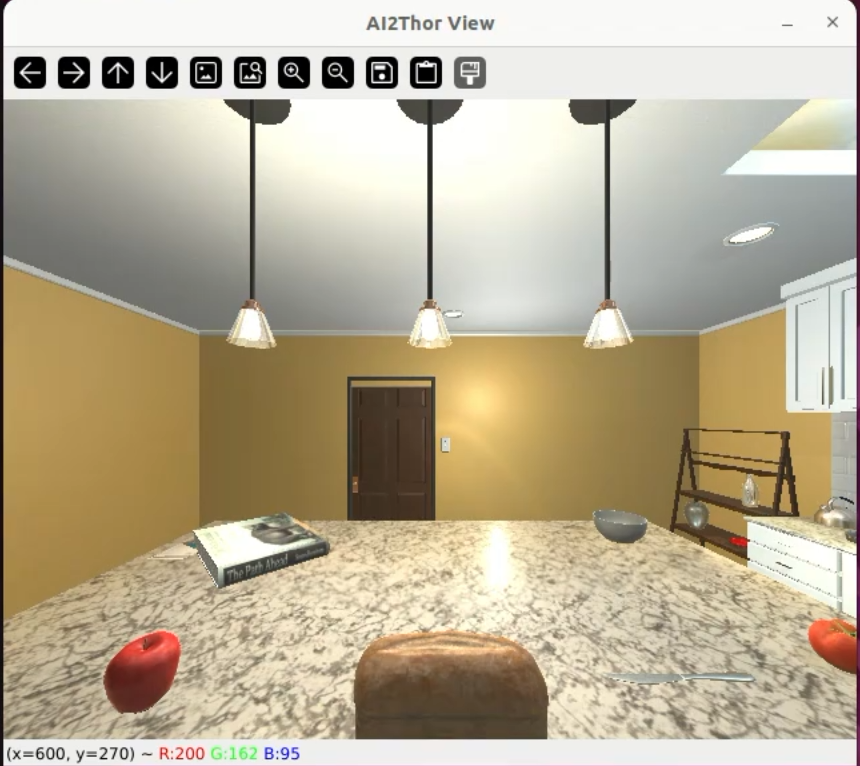
Demonstrations of humans actually completing tasks in the AI2-THOR environment.

AI2-THOR demonstration:
1
2
3
4
5
6
7
8
Human Expert

│ Complete the task

AI2-THOR 3D Environment


Expert Trajectory

e.g.

  • Task

    1
    Put the alarm clock in the drawer.
  • Expert Trajectory:

    1
    2
    3
    4
    5
    6
    7
    8
    9
    10
    11
    12
    13
    14
    15
    16
    17
    18
    19
    20
    21
    22
    23
    24
    25
    26
    27
    28
    29
    30
    31
    32
    33
    34
    35
    36
    37
    38
    39
    40
    41
    42
    Step 0
    Observation:
    Bedroom

    Action:
    go to desk


    Step 1
    Observation:
    Alarm clock is on desk

    Action:
    pickup alarm clock


    Step 2
    Observation:
    Holding alarm clock

    Action:
    go to drawer


    Step 3
    Observation:
    Drawer is closed

    Action:
    open drawer


    Step 4
    Observation:
    Drawer is open

    Action:
    put alarm clock in drawer


    Step 5
    Goal achieved

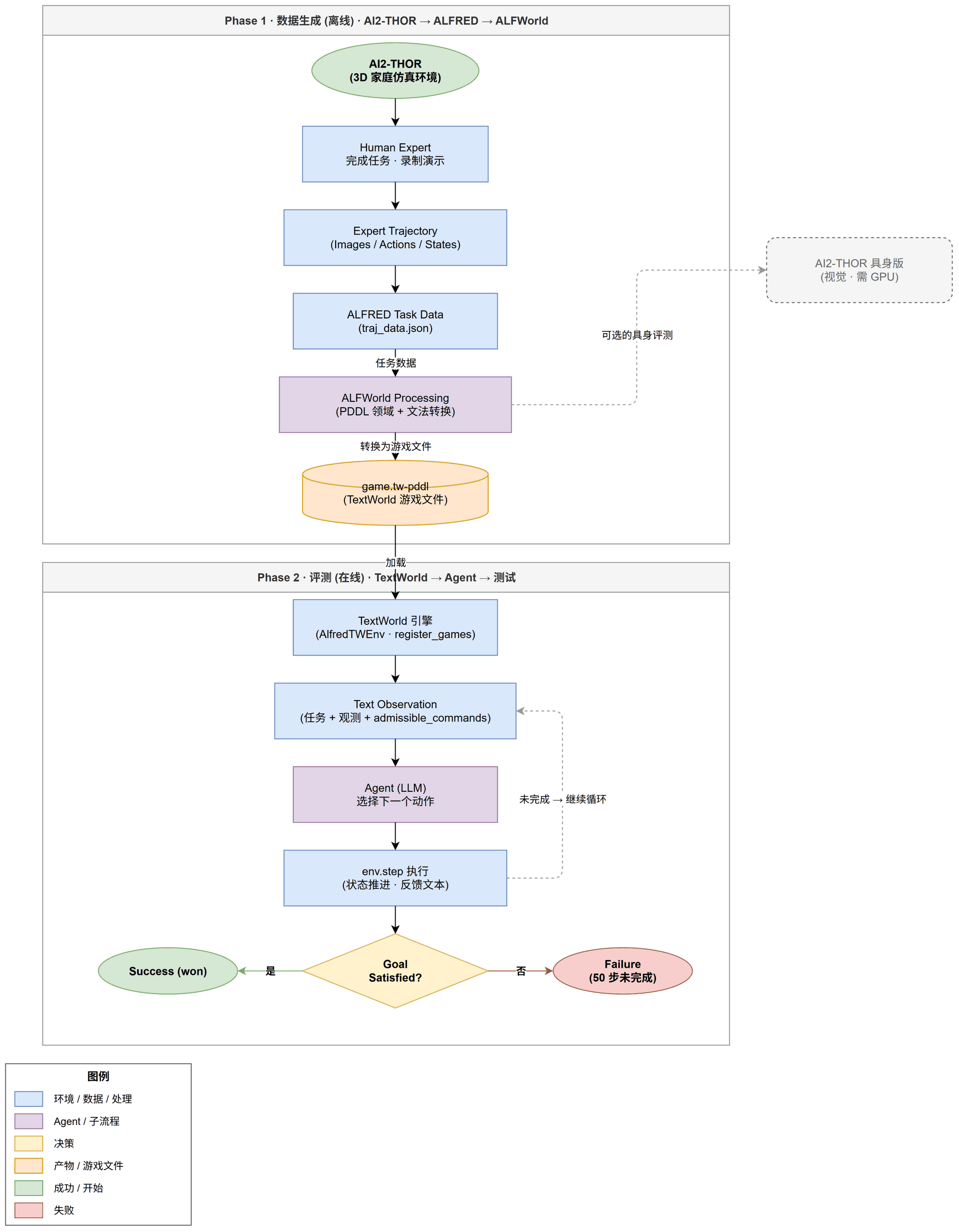
The task data of ALFWorld comes from ALFRED:

1
2
3
4
5
6
7
8
9
10
11
12
13
14
15
16
17
18
19
20
21
22
23
24
25
26
27
28
29
30
31
32
33
34
35
36
37
38
39
40
                 ALFRED

Human Expert Demo


Expert Trajectory

┌────────────────┼────────────────┐
│ │ │
▼ ▼ ▼
Images Actions States
│ │ │
└────────────────┼────────────────┘


ALFRED Task Data


ALFWorld Processing

┌─────────────┴─────────────┐
▼ ▼
TextWorld AI2-THOR
│ │
▼ ▼
Text Observation Visual Observation
│ │
▼ ▼
Your Agent Your Agent
│ │
└─────────────┬─────────────┘

Agent Trajectory


Goal Satisfied?

┌─────┴─────┐
▼ ▼
Success Failure

2.2.2 traj_data.json

To describe what the task is, including its task type, goal parameters, scene, expert trajectory, etc.

The traj_data.json can be divided into following parts:

1
2
3
4
5
6
7
8
traj_data.json
└───────
├── images
├── pddl_params
├── plan
├── scene
├── turk_annotations
└── task_id & task

2.2.2.1 images

  • images structure:

    1
    2
    3
    4
    5
    6
    7
    8
    9
    "images": [
    ...
    {
    "high_idx": 0,
    "image_name": "000000000.png",
    "low_idx": 0
    }
    ...
    ]

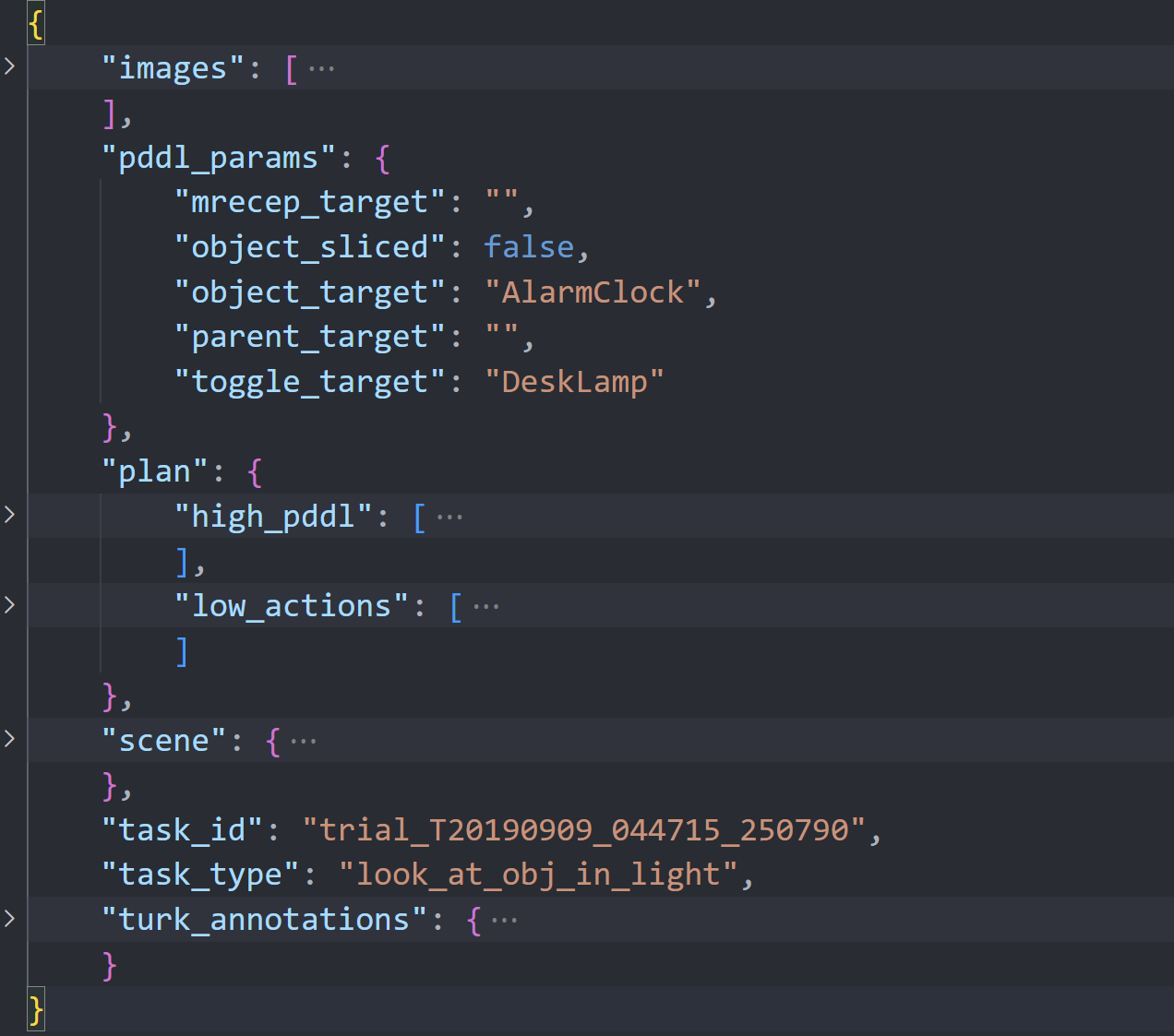
2.2.2.2 pddl_params

  • pddl_params structure:

    PDDL(Planning Domain Definition Language) is used to generate a text world.

    1
    2
    3
    4
    5
    6
    7
    "pddl_params": {
    "mrecep_target": "",
    "object_sliced": false,
    "object_target": "AlarmClock",
    "parent_target": "",
    "toggle_target": "DeskLamp"
    }
    • mrecep_target: movable receptacle
    • object_sliced: If object should be sliced
    • object_target: target object
    • parent_target: parent target
    • toggle_target: The switch should be toggled

2.2.2.3 plan

  • plan main structure:

    1
    2
    3
    4
    "plan": {
    "high_pddl": [...],
    "low_actions": [...]
    }
    • high_pddl is to describe high-level of expert trajectory. e.g .
      • GotoLocation / PickupObject / PutObject /…
    • low_actions is to describe concrete actions e.g.
      • LookDown / Forward / RotateLeft /
  • high_pddl and low_actions are corresonding

    e.g.

    1
    2
    3
    4
    5
    6
    7
    8
    9
    10
    11
    12
    13
    high_pddl[0]

    ├── low_actions[0]
    ├── low_actions[1]
    ├── low_actions[2]
    ├── ...
    └── low_actions[n]

    high_pddl[1]

    ├── low_actions[n+1]
    ├── low_actions[n+2]
    └── ...
    1
    2
    3
    4
    5
    6
    7
    8
    9
    10
    11
    12
    13
    14
    15
    16
    17
    18
    19
    20
    21
    22
    high_pddl

    ├── [0] GotoLocation(dresser)
    │ │
    │ │ high_idx = 0
    │ ▼
    │ low_actions
    │ ├── LookDown_15
    │ ├── RotateLeft_90
    │ ├── MoveAhead
    │ ├── MoveAhead
    │ └── ...

    ├── [1] PickupObject(mug)
    │ │
    │ │ high_idx = 1
    │ ▼
    │ low_actions
    │ ├── ...
    │ └── PickupObject

    └── [2] ...
  • A action description may includes many visual information but TextWorld do not need:

    1
    2
    3
    4
    5
    6
    7
    8
    9
    10
    11
    12
    13
    14
    15
    {
    "api_action": {
    "action": "ToggleObjectOn",
    "objectId": "DeskLamp|..."
    },
    "discrete_action": {
    "action": "ToggleObjectOn",
    "args": {
    "bbox": [...],
    "mask": [...],
    "point": [88, 111]
    }
    },
    "high_idx": 3
    }

2.2.2.4 scene

“==scene==” is to what is the state of the world when the task begins.

1
2
3
4
5
6
7
8
9
10
11
12
13
14
15
16
17
18
19
20
"scene": {
"dirty_and_empty": false,
"floor_plan": "FloorPlan323",

"init_action": {
"action": "TeleportFull",
"horizon": 30,
"rotateOnTeleport": true,
"rotation": 90,
"x": 0.25,
"y": 0.9009992,
"z": 1.0
},

"object_poses": [...],
"object_toggles": [...],

"random_seed": 3619629972,
"scene_num": 323
}

2.2.2.5 turk_annotations

1
2
3
4
5
turk_annotations
└── anns
├── annotation 1
├── annotation 2
└── annotation 3

For one same task, there may exists many different annotations:

e.g.

1
Look at an alarm clock by the light of a lamp.

1
Look at the clock under the lamp.

For a concrete annotations:

1
2
3
4
5
6
7
8
9
10
11
12
13
14
15
16
17
{
"assignment_id": "A3UF6XXFFRR237_3I0BTBYZA0CU1NAVSL6DC5BBKB0Y0X",
"high_descs": [
"go to the table with the safe ",
"pick up the clock",
"take the clock to the desk",
"turn on the lamp"
],
"task_desc": "look at the clock under the lamp",
"votes": [
1,
1,
1,
1,
1
]
}

2.2.3 initial_state.pddl

Describe the initial world state of the task.

The initial_state.pddl can be divided into 3 main parts:

1
2
3
4
5
6
7
8
9
10
initial_state.pddl

├── 1. :objects
│ └── Define: "What do the Env have"

├── 2. :init
│ └── Define: "What is the state of Env now"

└── 3. :goal
└── Define: "Final State of the Env"

e.g.

  • object:

    1
    2
    3
    4
    5
    6
    agent1 - agent
    Mug_xxx - object
    MugType - otype
    Desk_xxx - receptacle
    DeskType - rtype
    loc_xxx - location
  • init:

    1
    2
    3
    4
    (atLocation agent1 loc_xxx)
    (inReceptacle Mug_xxx Desk_xxx)
    (pickupable Mug_xxx)
    (openable Drawer_xxx)
  • goal:

    1
    2
    3
    4
    5
    6
    7
    8
    9
    10
    11
    12
    13
    14
    15
    16
    17
    18
    19
    20
    21
    22
    23
    24
    (:goal
    (and
    (exists (?ot - object
    ?r - receptacle
    ?a - agent
    ?l - location)
    (and
    (objectType ?ot DeskLampType)
    (toggleable ?ot)
    (isToggled ?ot)
    (receptacleAtLocation ?r ?l)
    (atLocation ?a ?l)
    (inReceptacle ?ot ?r)
    )
    )
    (exists (?o - object
    ?a - agent)
    (and
    (objectType ?o AlarmClockType)
    (holds ?a ?o)
    )
    )
    )
    )

2.2.4 game.tw-pddl

Convert the task into game rules that can be executed by TextWorld.

1
2
3
4
5
6
7
8
9
10
11
12
13
14
15
16
game.tw-pddl

├── pddl_domain
│ └── Defines the "game rules"

├── grammar
│ └── Defines the interface between "PDDL ↔ natural language"

├── pddl_problem
│ └── Defines the "world, initial state, and goal" of this specific task

├── solvable
│ └── Indicates whether this task is solvable

└── walkthrough
└── A known feasible expert solution path

The game.tw-ddl is composed of different parts:

1
python -c "import json; d=json.load(open('game.tw-pddl', encoding='utf-8'), strict=False); open('domain.pddl','w',encoding='utf-8').write(d['pddl_domain']); open('problem.pddl','w',encoding='utf-8').write(d['pddl_problem']); open('grammar.txt','w',encoding='utf-8').write(str(d['grammar'])); open('walkthrough.txt','w',encoding='utf-8').write(str(d['walkthrough'])); print('solvable =', d['solvable'])"

2.2.5 Summary

File Function Child Item
traj_data.json Task / Expert Trajectory taskpddl_paramssceneplanturk_annotationsimages
initial_state.pddl ****The symbolic state and goal of the task**** :objects:init:goal
game.tw-pddl Change Task into TextWorld Game pddl_domainpddl_problemgrammarsolvablewalkthrough

2.3 Task Workflow

2.3.1 Entrance

alfworld/scripts/run_eval.py

1
2
3
4
5
6
7
8
9
10
11
12
13
14
15
16
17
18
19
20
21
22
23
24
25
26
27
28
29
30
31
32
33
34
35
36
37
38
39
40
41
42
43
44
45
46
47
48
49
50
51
52
53
54
55
56
57
58
59
60
61
62
def run_eval():
# Load Config
config = generic.load_config()
# Create Agent
agent = TextDAggerAgent(config)
# Create Output Direction
output_dir = os.path.expandvars(config["general"]["save_path"])
if not os.path.exists(output_dir):
os.makedirs(output_dir)

# load trained model from checkpoint
data_dir = os.path.expandvars(config["general"]["save_path"])
if agent.load_pretrained:
print("Checking {} for {}".format(data_dir, agent.load_from_tag))
if os.path.exists(data_dir + "/" + agent.load_from_tag + ".pt"):
agent.load_pretrained_model(data_dir + "/" + agent.load_from_tag + ".pt")
agent.update_target_net()

# Dagger & DQN
training_method = config["general"]["training_method"]
# Testdata Paths
eval_paths = config["general"]["evaluate"]["eval_paths"]
#TextWorld or Thor
eval_envs = config["general"]["evaluate"]["envs"]
# for Thor
controllers = config["general"]["evaluate"]["controllers"]
# repeat times
repeats = config["general"]["evaluate"]["repeats"]

# iterate through all environments
for eval_env_type in eval_envs:
# iterate through all controllers
for controller_type in (controllers if eval_env_type == "AlfredThorEnv" else ["tw"]):
print("Setting controller: %s" % controller_type)
# iterate through all splits
for eval_path in eval_paths:
print("Evaluating: %s" % eval_path)
config["general"]["evaluate"]["env"]["type"] = eval_env_type
config["dataset"]["eval_ood_data_path"] = eval_path
config["controller"]["type"] = controller_type

alfred_env = get_environment(config["general"]["evaluate"]["env"]["type"])(config, train_eval="eval_out_of_distribution")
eval_env = alfred_env.init_env(batch_size=agent.eval_batch_size)

# evaluate method
if training_method == "dagger":
results = evaluate_dagger(eval_env, agent, alfred_env.num_games*repeats)
elif training_method == "dqn":
results = evaluate_dqn(eval_env, agent, alfred_env.num_games*repeats)
else:
raise NotImplementedError()

# save results to json
split_name = eval_path.split("/")[-1]
experiment_name = config["general"]["evaluate"]["eval_experiment_tag"]
results_json = os.path.join(output_dir, "{}_{}_{}_{}.json".format(experiment_name, eval_env_type.lower(), controller_type, split_name))

with open(results_json, 'w') as f:
json.dump(results, f, indent=4, sort_keys=True)
print("Saved %s" % results_json)

eval_env.close()

2.3.2 Collect Game List

alfworld/alfworld/agents/environment/alfred_tw_env.py:118

1
2
3
4
5
6
7
8
9
10
11
def __init__(self, config, train_eval="train"):
print("Initializing AlfredTWEnv...")
self.config = config
self.train_eval = train_eval

if config["env"]["goal_desc_human_anns_prob"] > 0:
msg = ("Warning! Changing `goal_desc_human_anns_prob` should be done with"
" the script `alfworld-generate`. Ignoring it and loading games as they are.")
print(colored(msg, "yellow"))

self.collect_game_files()

2.3.3 Start TextWorld

alfworld/alfworld/agents/environment/alfred_tw_env.py:245

1
2
3
4
5
6
7
8
9
10
11
12
13
14
15
16
17
18
19
20
21
22
23
24
  def init_env(self, batch_size):
# Randomization is available when training
# not available when evaluating
domain_randomization = self.config["env"]["domain_randomization"]
if self.train_eval != "train":
domain_randomization = False
# ...

# Register a new Gym environment.
# Hope environment return info including 'won'
# admissible_commands
request_infos = textworld.EnvInfos(won=True, admissible_commands=True, extras=["gamefile"])

# ...

env_id = textworld.gym.register_games(self.game_files, request_infos,
batch_size=batch_size,
asynchronous=True,
max_episode_steps=max_nb_steps_per_episode,
wrappers=wrappers)
# Launch Gym environment.
env = textworld.gym.make(env_id)
return env

Core code:

1
2
3
4
5
6
7
8
env_id = textworld.gym.register_games(
self.game_files,
request_infos,
batch_size=batch_size,
asynchronous=True,
max_episode_steps=max_nb_steps_per_episode,
wrappers=wrappers
)

game_files is the set of game.tw-pddl

Gym is a standardized environment for agents to interact with.

2.3.4 Evaluation

1
2
3
4
5
6
7
8
9
10
11
12
13
14
15
16
17
18
19
20
21
22
23
24
25
26
def evaluate_dagger(env, agent, num_games, debug=False):
# fixed seed, 42
env.seed(42)

# obs = observation, infos = extra info
obs, infos = env.reset()

# current test item
game_names = infos["extra.gamefile"]

# reset agent's information
agent.init(batch_size)

# previous action + current observation
execute_actions = []
...
execute_actions.append("restart")

# task description
observation_strings = list(obs)

task_desc_strings, observation_strings = \
agent.get_task_and_obs(observation_strings)

task_desc_strings = agent.preprocess_task(task_desc_strings)
observation_strings = agent.preprocess_observation(observation_strings)

Input for Agent like:

1
2
3
4
5
6
Task:
look at the alarm clock under the lamp

Observation:
You are in the bedroom.
You see a dresser...
1
action_candidate_list = list(infos["admissible_commands"])

Start Loop:

1
2
3
4
for step_no in range(agent.max_nb_steps_per_episode):
# ...
obs, _, dones, infos = env.step(execute_actions)
# ...